Service
Aesthetic Medicine
Patients seek aesthetic medical (known as cosmetic or non-surgical) treatments for a number of different reasons, such as;
- Minimise the ageing process – particularly on the face, neck, decolletage, but increasingly also of the hands, and other areas of the body, for a more holistic and encompassing rejuvenation.
- To enhance their appearance – e.g. less prominent cheekbones, overactive muscles of facial expression or mastication (‘chewing muscles’)
- Excessive sweating of palms of hands, arm pits, lower back, soles of feet, other areas, or the medical condition called hyperhidrosis
- Bruxism or teeth grinding
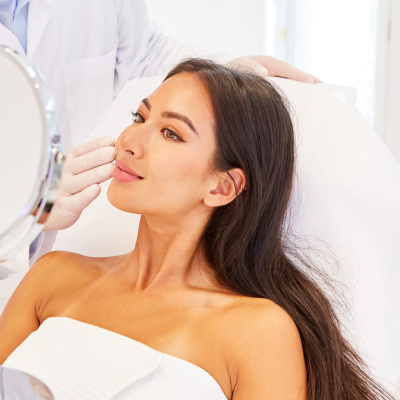
What are the components of the face and how are they affected by sun exposure, lifestyle and the aging process?
Appearance of the skin: as you age, you experience a loss of collagen, elastin and other vital connective tissue elements, which results in sagging of the face, the development of jowls and marionette lines. In addition, the face can develop laughter lines, frown lines, forehead lines and crow’s feet around the eyes. Pores can become more pronounced and the skin can take on a rougher texture. Smoking, sun exposure (tanning, but in particular, episodes of sunburn), diet and sleep also affect the skin.
Volume of fat: the amount of fat and it’s position in your face reduces with aging. The latter is due to degenerative laxity of delicate facial ligaments and can cause hollows beneath the eyes, drooping around the nose and mouth and the appearance of a double chin.
Facial bone changes: during aging there is facial bone resorption (loss) leading to less structural support for the overlying structures and this changes the dimensions and contour of the face. Even without ageing, some patients, for example, do not have prominent cheekbones or chins.
What are the components of the hand and how are they affected by sun exposure, lifestyle and the aging process?
Appearance of the skin: After the head and neck, our hands are the next most sun-exposed part of our body. Similar to the face, with the hands skin quality, texture, wrinkles and pigmentation manifest damage from the sun, smoking and the aging process.
Volume loss: In the hands, this deeper layer volume loss from age-related fat atrophy can give that more skeletonised appearance to the hand, with veins and tendons becoming more pronounced.
Hand bone/joint changes: This natural occurrence, most commonly of the base of thumb, can be made more prominent by the changes to the volume of fat and skin changes above.
Find out more and book an initial consultation via the link below.
Dr Anita only uses the highest quality products that have been shown to be effective for the specific indication.
Treatments available



A combination of the above treatments will often work together for more optimal results.
1. Skincare Advice
Dr Anita will review the general measures that can be taken by all patients to improve the quality of their skin. In addition, she can inform of the various agents that have been proven to be effective in improving the skin and formulate a bespoke medical-grade skin care routine that will provide these agents at the appropriate strength to effect change.
2. Botox injections®
Botulinum toxin® is a commonly used injectable medication used in aesthetics.
It can be used for a range of treatments:
- Reduce the appearance of wrinkles on the face
- Provide a subtle neck lift
- Lower face shaping (reducing ‘square jaw’ appearance)
- Excessive sweating of palms, armpits, lower back, soles of feet, and other areas
- Teeth grinding
Price:
Initial consultation (30 mins) – £150. Price of Botox® is dependent on treatment areas.
Time:
30 minutes, after initial consultation
Pain:
Mild
Recovery:
30 minutes
Results seen:
start at 3 – 5 days, 10 – 14 days after treatment, earlier for treatment of sweating
Areas:
facial muscles, mastication (‘chewing’) muscles, neck, arm pits, palms of hand, sole of feet, other areas
Frequency:
depends upon indication, face/neck, neck 3-4 times per year, other areas 2-3 times per year
How does Botox work?
- Temporary blocks the contraction of muscles of facial expression, of eating (mastication), related to sweat glands
- This reduces the strength of the underlying muscle contraction/sweating
- Effect is temporary and is dose dependent
Benefits of precisely administered Botox
- It is a minimally invasive procedure with minimal down time
- Dependent on treatment target;
- Youthful, refreshed and rejuvenated appearance to face, neck
- Slimming of the lower face
- Reduction in sweating
- Reduced teeth grinding
Post-treatment advice
- Avoid touching or massaging treated areas for the rest of the day as the product can migrate
- Do not apply any make-up for the remainder of the day
- Keep the treated area clean and dry and gently pat dry
- Avoid strenuous exercise, sauna, jacuzzi, facial or hot showers for the remainder of the day
- Avoid skin care products with glycolic acid, retinol or vitamin C for 24 hours post-procedure
Risks
- Uncommon: bruising or headaches
- Rare: droopy eyebrows, eyelids or asymmetry
Contraindications
This treatment is not suitable for patients who are;
- Pregnant or breastfeeding
- Known to have a previous allergic or hypersensitive reaction to Botulinum toxin
- Known to have neuromuscular disorders, e.g. myasthenia gravis or Lambert-Eaton syndrome
3. Dermal Fillers
Dermal fillers are composed of hyaluronic acid, a synthetic version of the naturally occurring substance in your skin.
It can be used for a range of treatments:
- To treat fine lines and deep wrinkles
- To improve age-related prominence of natural aesthetic lines e.g. the nasolabial fold, marionette lines etc.
- To improve age-related volume loss and sagging of these depleted fat pads of the face
- To enhance cheeks and chin due to age related facial bone changes
- Improve contour irregularities of the nose
- Improve volume depletion below the eye (‘tear trough’)
Price:
from £450
Time:
30 – 45 minutes
Pain:
mild discomfort (can use local anaesthetic numbing cream or injection)
Recovery:
swelling can last up to 2 weeks
Results seen:
can be seen immediately although there may be subtle swelling afterwards for up to 2 weeks
Areas:
face, neck, hands
Frequency:
9 – 15 months, depending upon indication and product used
Pre-treatment:
7 days prior cease irritant topical agents (glycolic acid, retinol, vitamin C), take course of antivirals if history of cold sores (herpes simplex type 1 virus) if having dermal filler to lip
How does it work?
Dermal fillers temporarily provide volume to enhance and contour the face. The products used in Anita’s practice include Juvederm Vycross® range and Teoxane® range.
Benefits
- Soften wrinkles
- Reduces the severity of natural aesthetic lines that become more prominent with ageing
- Restores volume loss and gently lifts the depleted fat pads of the face
- Augments the underlying bony skeleton to improve contour and enhance facial features e.g. cheeks and chin
- Harmonises contour irregularities of the nose
- Addresses the volume element of the ‘tear trough’
How can I optimise treatment?
- Wrinkles and lines are caused by muscle activity and treating them with Botulinum toxin can be effective. However, the two treatments should not be combined on the same day. Dr Anita prefers a step-wise approach, often treating the muscles first as this can soften lines. Dermal filler, if required, can be used after a two-week interval.’
- Treatments to stimulate collagen, improve skin elasticity and texture are also good partners, such as Morpheus8 (radiofrequency and microneedling combined). However, it is important to stage treatments appropriately for safety and to optimise their effect.
Post-treatment advice
- Specific aftercare for lip filler treatment: avoid using straws for 4 – 5 days
- Avoid touching or massaging the treated areas for the rest of the day as the product can migrate
- Do not apply any make-up for the remainder of the day
- Keep the treated area clean and dry and allow to air dry
- Avoid strenuous exercise, sauna, jacuzzi, facial or hot showers for the remainder of the day
- Avoid skin care products with glycolic acid, retinol or vitamin C for 24 hours post-procedure
- Don’t apply sun protection 24 hours post-procedure
Risks
- Uncommon: bruising and swelling
- Rare: vascular occlusion, migration, granulomas or asymmetry
Contraindications
This treatment is not suitable for patients who are
- Pregnant or breastfeeding
- Known to have a previous allergic or hypersensitive reaction to hyaluronic acid
- Currently experiencing an active skin infection in the treatment area
4. Skin Boosters
There are various skin boosters available that can help to enhance the skin quality. These boosters come in the form of non-cross-linked hyaluronic acid, polynucleotides, and exosomes. Hyaluronic acid, a synthetic version of the naturally occurring substance present in the skin, improves skin texture, elasticity, hydration and overall appearance. Polynucleotides are long strands of DNA fragments, derived from salmon or trout sperm and can enhance the skin’s quality and renew it with regenerative effect over time.
It can be used for a range of treatments:
- Fine wrinkles
- Age-related volume loss and sagging of depleted fat pads of the face
- Acne scars
- Large pores
- Dull, dry skin
- Hyperpigmentation
Price:
from £500 per session (Polynucleotides Plinest® /Ameela®), from £600 per session (Profhilo)®
Time:
30 – 45 minutes
Pain:
mild (can use local anaesthetic numbing cream or injection)
Recovery:
swelling can last < 24 – 48hrs
Results seen:
up to 3-4 weeks
Areas:
face, scalp, neck, decolletage, hands, other areas
Frequency:
starting course every 3 – 4 weeks, for 2 – 3 sessions depending upon skin condition, and the age of the patient. Then 2 – 3 times per year.
Benefits
- Soften wrinkles
- Restores firmness
- Remodels sagging skin
- Improve the appearance of acne scars, large pores
- Brightens skin
- Improves texture
How does Profhilo® / Ameela® work?
Profhilo® is an example of an injectable hyaluronic acid gel that hydrates the skin and stimulates fibroblasts. It is known as an ‘internal moisturiser’ and can be used for the face/decolletage, and hands. There are formulations for the eye area, scalp, and face/decolletage/body.
How does Plinest®/Ameela work?
Plinest® is composed of highly purified polynucleotides (strands of DNA) which stimulate fibroblast cells within the dermis to stimulate collagen production. Skin quality is enhanced and the skin is lifted and renewed for a more even complexion. It can also improve the appearance of acne scars, large pores as well as dry dull skin. There are formulations for the eye area, scalp, and face/decolletage.
How can I optimise treatment?
Post-treatment advice
- Avoid touching or massaging the treated areas for the rest of the day as the product can migrate
- Do not apply any make-up for the remainder of the day
- Keep the treated area clean and dry and allow to air dry
- Avoid strenuous exercise, sauna, jacuzzi, facial or hot showers for the remainder of the day
- Avoid skin care products with glycolic acid, retinol or vitamin C for 24 hours post-procedure
- Don’t apply sun protection 24 hours post-procedure
Risks
- Uncommon: bruising or swelling
Contraindications
This treatment is not suitable for patients who are;
-
- Pregnant or breastfeeding
- Known to have a previous allergic or hypersensitive reaction to hyaluronic acid
- Currently experiencing an active skin infection in the treatment area
5. Hand Rejuvenation
After our face, our hands are the next direct extension of our persona into the world, to interact with others, as well as their obvious functional requirements to look after ourselves and our loved ones.
All aesthetic and reconstructive hand procedures or operation requires an intimate knowledge of its anatomy/physiology/biomechanics, and this holds true for hand rejuvenation treatments as well. Safety is the top priority.
What treatment options are available?
Each treatment plan is created bespoke, to address the specific needs to rejuvenate your hands. As such, price, duration of treatment, level of discomfort, recovery time, time to see results and frequency of treatment will vary. Most patients are comfortable with topical local anaesthesia or local anaesthetic nerve blocks to the hand to deliver treatment.
To address the skin:
- Sunscreen is critical
- Medical-grade skin care
- Skin boosters, such as Profhilo and polynucleotides
- BroadBand light therapy
- Laser therapies
To address volume:
- Dermal fillers or
- Fat grafting
- Dr Anita is a member of the Aesthetic Complications Expert (ACE) Group is a not-for-profit organisation that produces expert guidance on the diagnosis and management of complications in aesthetic medicine
- ACE Group recommends standardised, high-quality training is needed, along with continuing professional development to ensure patient safety is paramount.
Find out more and book an initial consultation via the link below.